


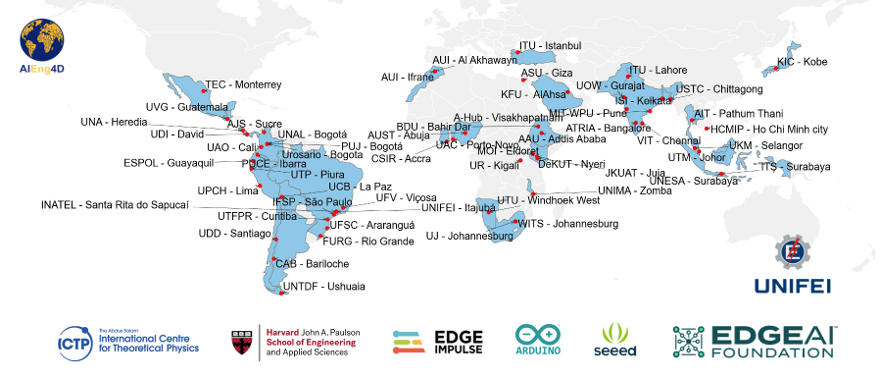
AIEng4D (former TinyML4D)

University Courses
UNIFEI-IESTI01: TinyML - Machine Learning for Embedded Devices
UNIFEI-IESTI05: EdgeAI - Edge Machine Learning Systems Engineering
Books
Machine Learning Systems by Prof. Vijay Janapa Reddi (contributor)
Generative AI at the Edge: Running SLMs with Arduino UNO Q and llama.cpp
Edge AI Engineering: Hands-on with the Raspberry Pi
TinyML Made Easy: Hands-On with Seeed Studio Devices
TinyML Made Easy: Hands-On with the Nicla Vision
XIAO: Big Power, Small Board - Mastering Arduino and TinyML
Workshops & Lectures
Recent Highlights
-
Vistage - Chile (2026) - IA Abierta y Local [Slides] [Video 1] [Video 2]
-
UPB - Bucaramanga, Colombia (2026) - TinyML y Edge AI: ingeniería al servicio de las comunidades [Slides]
-
PUCE - Ibarra (2026) - Generative AI at the Edge - Introduction [Material] [Video]
-
JAVERIANA (2026) — Generative AI at the Edge [Material]
-
JAVERIANA (2025) — Generative AI at the Edge [Material]
-
AI for Everyone, Everywhere — MFSH25, Shenzhen, China (2025)
-
Workshop for Educators (ARM/Harvard) — ASEE25, Montreal, Canada (2025)
ICTP Workshops
-
Workshop on TinyML for Sustainable Development – ICTP – Universidad Javeriana – Bogotá, Colombia (2025)
-
TinyML for Sustainable Development – ICTP/Malawi University, Zomba, Malawi (2025)
-
Workshop on TinyML for Sustainable Development – IBM/ICTP – Brazil (2024)
-
SciTinyML: Scientific Use of Machine Learning on Low-Power Devices – Virtual – (2024)
-
SciTinyML: Scientific Use of Machine Learning on Low-Power Devices (2023)
-
SciTinyML: Scientific Use of Machine Learning on Low-Power Devices (2022)
-
SciTinyML: Scientific Use of Machine Learning on Low-Power Devices (2021)
WALC — Latin America & Caribbean
-
WALC 2025 - Virtual - “Applied AI”
-
WALC 2024 - Virtual - “Applied AI”
-
WALC 2023 - Ecuador - “Applied AI”
-
WALC 2022 - Panama - “Applied AI”
University Lectures & Talks
-
South Dakota State University (SDSU): AI in Agriculture [Slides] [Video]
-
UNIFEI: From GPIO to GPT - Turning the Raspberry Pi into an AI Hub [Slides] [Video]
-
UPCH-Peru: TinyML Introduction and Edge Computing Vision w/ Arduino NICLA Vision
-
Morocco AI - Summer School [Material]
-
tinyML Talks: “Unleashing the Power of the New XIAO ESP32S3 Sense” [Slides] [Video]
-
PUC Ecuador - Bringing Intelligence to Sensors
-
Addis Ababa University (AAU) Workshop - Using Wio Terminal
-
UAO - Colombia - TinyML Introduction
-
CNMAC-22 - Campinas, Brazil
Academic Papers
AFIB_SR_detection_TinyML
On Device - Predictive Model
Classifying mosquito wingbeat sound using TinyML
Use of Edge Machine Learning for a Non-Invasive Beehive Monitoring System
Articles
Three Boards, One Question: Where Should a Small Language Model Run? Orange Pi Zero 3W, Raspberry Pi 5, and Arduino UNO Q (2026)
Christmas 1970, Rebuilt in a Browser (2026)
Open and Local Is Not a Compromise Anymore (2026)
Running Small Language Models on a Raspberry Pi 5: Gemma 4 E2B and Qwen3.5 4B with MTP (2026)
All articles →
Tutorials
Arduino UNO Q Hands-On Tutorials
Small Language Models on the Orange Pi Zero 3W: Headless Setup, llama.cpp, Chat, and Image Captioning
YOLOInfer: Running YOLO on Your Phone — No App Store Required [Live Demo] [Material]
Exploring the CrowPanel Advanced 10.1-inch ESP32-P4 HMI Display
SLMs at the Edge: A Guide to Local Inference on PC, Raspberry Pi, and Arduino UNO Q
From Ollama to llama.cpp: Multimodal Inference on the Edge (Raspberry Pi 5)
Edge Machine Learning in Practice e-Book (work in progress)
TinyML LSTM Model [Temperature Prediction Tutorial] [Material]
Grove Vision AI Module (V2) [Computer Vision at the Edge - Tutorial] [Material]
SONY Spresense and SensiEDGE CommonSense [Sensor Data Fusion Tutorial] [Material]
ARDUINO NICLA Vision - Computer Vision [Material] [Video-ES]
XIAO ESP32S3 Sense - Audio / Motion / Vision
ESP32 TinyML - Audio / Motion / Vision
XIAO-BLE-Sense - Audio / Motion / Datalogger / MicroPython
Press
Small AI Models Gain Traction Around the World — IEEE Spectrum (2026)
What’s tinyML? The Global South’s alternative to power-hungry, pricey AI — Science (2025)
All coverage →
About Me
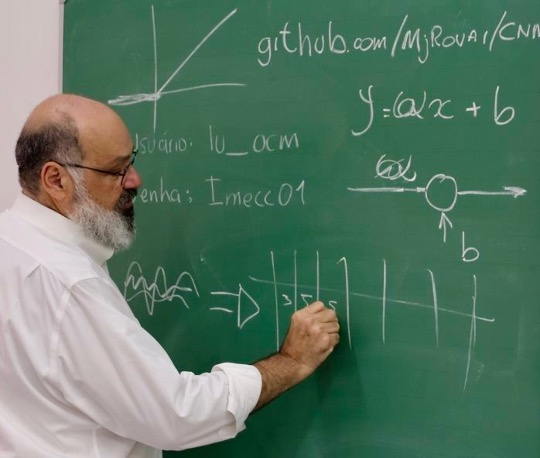
This site is a personal hub for my work with the AIEng4D academic network — the courses, books, workshops, and tutorials gathered here. A little about me:
Marcelo Rovai is a Brazilian engineer based in Chile, working on Edge AI and TinyML education. He is a volunteer professor at the Federal University of Itajubá (UNIFEI), Brazil, where he holds the title of Professor Honoris Causa and teaches embedded machine learning courses that have reached students across Latin America and beyond.
His open e-books and tutorials, published on GitHub and Hackster.io, are used by universities and makers worldwide. He is Co-Chair of the AIEng4D Academic Network (formerly TinyML4D) and of the EDGE AI Foundation’s Academia-Industry Partnership (EDGE AIP), initiatives that bring AI engineering education to universities in Latin America, Africa, and Asia.
Before moving to academia, he built a career in industry at Avibras Aerospace, AT&T, NCR, and IGT, where he served as Vice President for Latin America. He holds an engineering degree from UNIFEI, a specialization from the Polytechnic School of the University of São Paulo (POLI/USP), an MBA from IBMEC (INSPER), and a Master’s in Data Science from Universidad del Desarrollo (UDD), Chile.
These materials are part of the AIEng4D initiative, making Embedded & Edge Machine Learning education available to everyone, with an emphasis on enabling innovative solutions for the unique challenges faced by Developing Countries.